/GFJ%202027/Logos/GFJ%202027%20Logos/SVG/gfj2027_logo_revwht.svg)
/GFJ%202027/Logos/GFJ%202027%20Logos/PNG/gfj2027_logo_revwht.png?width=1458&height=626&name=gfj2027_logo_revwht.png)
.png?width=300&name=JFF%20blog%20thumbnail%20(1).png)
Financial News
[Global Report] "Korean Fintech, Technology Infrastructure Drives Growth More than Capital or Services"
Reporter Seo Hye-jin
2026.03.09.
Global Fintech Cooperation Platform Sopnendu Mohanty, GFTN Group CEO, Recommendations for the Korean Market
Korea has a strong digital infrastructure
Sufficient potential to be a strategic hub in the fintech sector
Growth rate slows if separated from traditional finance
A proportional regulatory approach is needed, like in Singapore
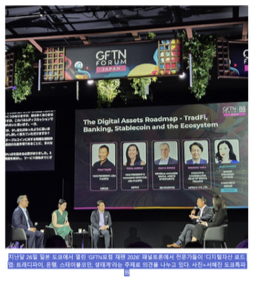
Photo Caption:
Experts discuss the topic of "Digital Asset Roadmap: Tradeify, Banks, Stablecoins, and the Ecosystem" at a panel discussion at the "GFTN Forum Japan 2026" held in Tokyo on the 26th of last month. Photo = Seo Hye-jin, Tokyo correspondent.
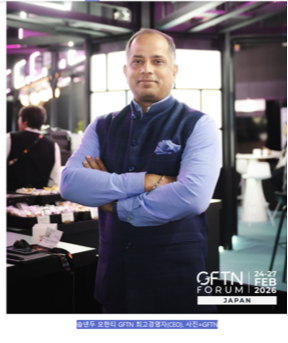
Sopnendu Mohanty, Group CEO of GFTN. Photo = GFTN
【Financial News Tokyo=Correspondent Hyejin Seo】 "South Korea's fintech industry is slower compared to the speed of internet growth. The growth rate will accelerate if policies are designed as a single integrated system rather than separating fintech from traditional finance," said Sopnendu Mohanty, CEO of GFTN (Global Finance & Technology Network), in an interview with our newspaper at the 'GFTN Forum Japan 2026' held at Belle Salle Tokyo Nihonbashi in Japan on the 26th of last month, evaluating the Korean fintech market in this way.
GFTN is a global fintech cooperation platform launched by the Monetary Authority of Singapore (MAS), and it is an organization that supports the construction of a digital financial ecosystem by connecting policy, capital, and technology. CEO Mohanty has continued to engage with the Korean market, including participating as an overseas speaker at 'Korea Fintech Week' held in Korea last November. The following is a Q&A.
―You visited Korea at the end of last year. How do you evaluate the Korean market?
▲Personally, I have high expectations for the Korean market. Historically, Korea has grown into one of the most digitally advanced countries in the world, backed by a robust internet infrastructure. However, I believe that the fintech sector hasn't grown at the same pace as the internet. Korea's robust digital infrastructure holds tremendous potential. Fintech is a highly regulated industry, and digital transformation relies heavily on policy and regulation. In Korea, I believe fintech, regulation, and digital transformation are all moving in tandem.
―Is there a problem with the pace of growth?
▲Many countries tend to think of fintech as a separate system from the traditional financial system. However, this isn't the case. The same financial system simply operates in different ways. Countries that integrate fintech and mainstream finance into a single policy track achieve faster adoption and growth. Separately separating them leads to different rates of development. Rather than focusing on speed, I believe the key is to combine fintech and finance into a single, integrated track and design policies based on that track to achieve comprehensive and collective technology adoption.
Policy always lags behind technology. The solution is "experimentation-based policy." Agile policy design is essential, driven by rapid testing, pilots, and experimentation.
―Compared to Singapore.
▲Singapore's regulatory framework doesn't treat fintech separately from banking. All elements—know your customer (KYC), anti-money laundering, consumer protection, market integrity, financial stability, technology risk management, and prudential regulation—are addressed within the same framework. If a bank engages in ten different functions, they are regulated across all ten. If a bank engages in just one function, they are regulated proportionally. This is proportional regulation. Singapore is adopting this approach.
―In Korea, the second phase of virtual asset legislation is facing difficulties. Differences between financial authorities, industry, academia, and the legal community remain unresolved on key issues.
▲ Trust in regulated stablecoins and tokenized deposits is high globally. This is compatible with central bank stability. While purely speculative cryptoassets are undesirable, regulated products can contribute to trade efficiency and financial improvement.
―What is Korea's desirable role in terms of geopolitics and capital flows?
▲Global supply chains are becoming more multipolar. Japan and Singapore serve as capital and service providers. Korea boasts a robust manufacturing and technological infrastructure. Korea can become a strategic hub, providing technology, capital, and leveraging its R&D capabilities to collaborate with emerging markets. More international cooperation is needed. I have four messages for Korea: accelerate reforms to facilitate technology adoption, expand international cooperation, attract global talent, and strive to become an international hub. Korea is already doing very well in the domestic market. It must further strengthen its international orientation.
Seo Hye-jin (sjmary@fnnews.com)
Copyright ⓒ Financial News. All rights reserved. Unauthorized reproduction and redistribution prohibited.